Have you ever thought about ad space?
We’re advertised to all the time. It feels sort of inescapable. But I think it could go further.
Recently, I logged into a WiFi network in a friend’s apartment that was provided by the building. The password to the WiFi was the name of the internet service provider. And, well, why not? It gets you to think about the name of the company. You’re aware of their services.
Why doesn’t every company do this? Most wireless networks come with some randomly generated password, but there’s nothing stopping them from making it Xfinity or Frontier or Ziply. Or, maybe they could advertise other services. That would give them a bit more security- you’re randomly assigned BuyDominosPizza or InvestIn$SHT. You could even have the password to change over time, like other kinds of ad space, which would keep the user thinking about the brands in question constantly.
This is, of course, fairly simple, and it’s restricted to the digital world which already has extremely pervasive advertising. One could argue that that space is already saturated.
What about cars? In a lot of ways, every car is an advertisement for its own brand, and dealerships often put stickers or license plate frames on the back of the car to advertise their own services. But why not advertise for other companies? NASCAR already does this, and the dealerships or manufacturers could do it as well.

How about advertising plastered on materials? You could sell advertisements on trim for wall decorations, or put it on wallpaper, or floor tiles. These would obviously be huge eyesores, but one could make them cheap, or market them to landlords: I believe that college town landlords or people offering subsidized housing would be interested in these products.
You could also engrave advertisements on structural members, or into pavement. It would be fairly cheap to use a roller to emboss advertisements in sidewalks, and it could help cities finance their maintenance. And, of course, you could put advertisements on government buildings, but that is rather boring.
You can put ads on every piece of individual life. Injection-molded products are especially easy for this- you can add a logo to the mold to emboss it on the final part, which would let you add advertising to a wide variety of plastic parts. Any stamped metal part would likely be suitable, although it would be wise to make sure that it’s a company with a good reputation, since the advertisements will likely be fairly permanent.
Advertisements could be put on ID badges, currency, paper (for writing on), envelopes, stamps, wallets, key fobs, doors, garages, paint cans—basically any ordinary physical surface you can think of. The more disposable, the easier it is to establish an advertising campaign, because a fast turnaround time means that companies can be more reactive to trends.
Beyond this, the world around us can be modified to be more filled with ads. New York City’s Times Square is famous for having enormous advertising screens, but with modern projector technology these ads could be displayed on the surfaces of most buildings at night. They could also be projected on roadways and sidewalks, like embossed advertising. You could play your advertisements out loud, blaring them in the air.

There are even some more radical proposals. A few companies have suggested placing ads in space, with constellations of satellites visible from the ground, or potentially even projected on the moon. I am not certain of the technical feasibility of these proposals, given the large scales required.
You could probably go further. With solar geoengineering, it might be possible to cause the sun’s light to shine in a way that marks advertisements on the ground, or carve advertising materials into the landscapes around cities, like the Hollywood sign, but advertising something much more specific.
Now, it may be fairly obvious why these advertising methods are not adopted. They would not achieve the goals of advertising: to increase public approval of products. Right?
Well, what if it’s not? Technically, the goal of advertising is to increase the purchases of relevant goods and products, not actually to improve brand approval, and it’s naive to think that advertising needs to be liked to be effective. Instead, awareness of a product can encourage someone to buy it, even if they have a negative perception. Hungry? Might as well go for the first food delivery you think of. Need a new phone? Well, there’s no reason not to at least think about what comes to mind first. New house? You could always check out that website you heard of the other day.
Even when these companies are incredibly obnoxious, people have an interest in convenience, and presenting a plausible solution to a problem makes it much harder to think of alternatives.
And, it should be considered that advertising is already incredibly obnoxious. Spam emails are pretty bad, and spam mail is even worse. The vast majority of the mail that Americans receive today is essentially useless. We all get pizza coupons, ads for energy efficiency inspections, and political fliers, just to count examples that I have personally received.
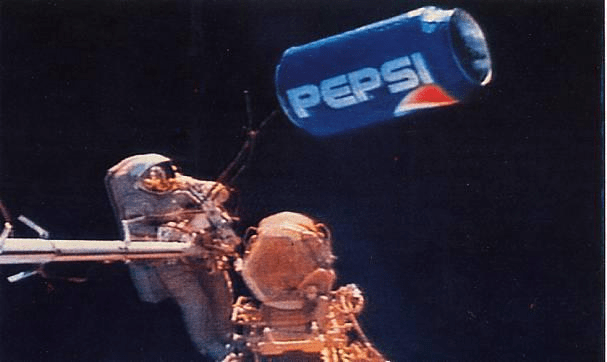
The space advertising satellites mentioned earlier might seem far-fetched, but there have been more limited space advertisements: promotional research on the ISS like the Hilton cookie baking experiment or sponsored whiskey aging stunts, the giant Pepsi can floated outside of Mir, and the Pizza Hut ads on the sides of Soyuz Rockets. Unlike NASA, Russia’s Roscosmos has no prohibitions against working with commercial actors.
For advertising in the physical world, on the ground, I have seen a few restaurants projecting their ads on the ground around them, something which is mostly just bizarre and probably done to help attract the eyes of the average person, since most people don’t look up or around themselves nearly enough. I certainly don’t. I have also seen some street preachers and political activists blasting noise on street corners, and if it works for them, it can work for corporations, and we already have the occasional sign-spinner or promo booth in public.
The rather silly-sounding idea of having ads plastered on civic infrastructure, like road repairs, has already been done. Domino’s pizza started repairing roads in different US states in 2018, spraying the slogan “paving for pizza” on top of the patches as they went.
Advertisements on random consumer goods are less common, but I’ve been given movie tickets with ads on them, and pretty much every receipt from a major chain is 50% advertising. Grocery bags come branded with the store’s name, and we see them when they are left as litter. Pizza box ads are common.
In truth, we already live in a world completely awash with advertisements. Every book is an advertisement for the other works of the author, and often the publishing company as well. Almost everything is branded, and some brands, like Mercedes-Benz, Gucci, or Apple, are even status symbols, with consumers happy to show off their latest purchases. LEGO bricks come with the company’s name embossed on each stud. People wear the merchandise of their favorite brands and only buy what they know is reputable.
This is not intended to criticize this behavior. This blog is, in itself, an advertisement for my writing. It’s reasonable to buy from brands that you find reliable and have experience with, and I certainly wear band t-shirts and shoes with recognizable logos on them. It would be nice to have more handmade items or stuff made by small creators… and yet, aren’t those items advertisements, in themselves?
I have a few linocut prints done by a small artist who lives in my general area. I’ve met them a few times, spoken to them, and I really appreciate their work. Other people have admired the prints on my wall, and I’ve been happy to tell them where I’ve gotten them from. They’re even signed, and came with business cards. Clearly, they come packaged with advertising. And I can’t find it in my heart to say that there’s anything wrong with that.
But the last time I bought a used car, I took off the branded license plate frame that came with it, even though the dealership was also a small business, it’s unobtrusive, and it’s even supporting a small, local business. I still threw it away, and felt offended, for some reason. Why should I care? It’s not the end of the world, the advertisement isn’t that obnoxious. But I threw away that frame anyway, even though the car itself is branded for a far larger and more manipulative automotive corporation.
I’m not sure where the line is. I certainly wouldn’t want to have to see ads for ChatGPT every time I look up at the night sky. But when I come home, I also don’t mind seeing those paintings with an artist’s name in the corner, and I ignore the fact that my computer monitors all have little tech company logos on the bottom and that almost all my food comes packaged with brand names and logos and copyrights and UPCs, even if that branding is as small as the sticker on an apple.

 J. E. Landau
Leave a comment