
I recently read the 2023 novel The Blighted Stars by Megan E. O’Keefe, and I found it moderately enjoyable. It’s somewhere between a zombie horror story, a (very contemporary) romance novel, and a space opera, but it also has most of the characteristics of cyberpunk. So do a lot of novels, these days.
In The Blighted Stars there is faster-than-light travel and radio, and the story concerns corporations traveling to other star systems to try and find habitable planets and mine for resources. There are also some light transhuman elements, although unsurprisingly it’s only boring stuff. People have cybernetics that enhance their bodies without actually requiring for any body parts to be replaced and the wealthy employers and their valuable employees all have a brain backup system, which can only make one copy of a person at a time.
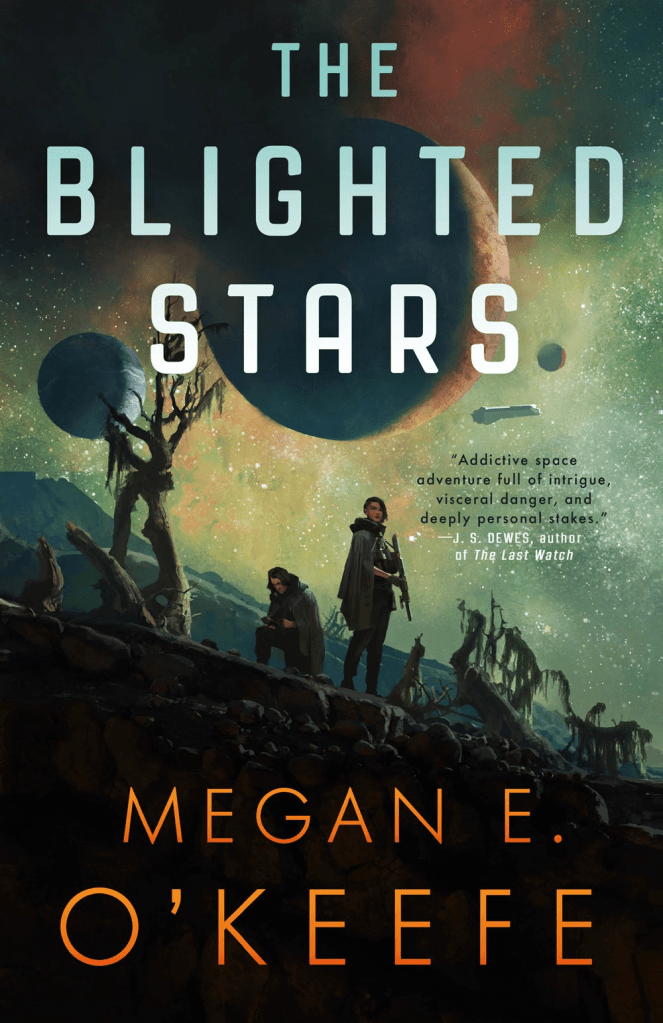
But the really interesting thing is that the novel is heavily cyberpunk. Humanity is ruled by a council of megacorporations that control everything. The average person is impoverished and picked over by corporations. The only hope of social mobility for most people is limited advancement through the corporate hierarchies.
The interesting thing, to me, is that cyberpunk in The Blighted Stars seems to be mostly an aesthetic choice. Although the megacorporations at the heart of the story are prominent and discussed frequently by the characters, they aren’t structurally all that different from aristocratic groups in other pieces of fiction. Making them corporations seems to be closer to set dressing, because the book doesn’t show the characters engaging with the corporations financially, only working for them. This is mostly limited by perspective. The protagonists of the novel are near the apex of the corporate hierarchy, or rebels outside of it, so we don’t get much perspective on what the average factory worker or office drone’s life is like.
But in my mind, this lack of engagement with the details of cyberpunk writing reflects how universal cyberpunk ideas have become in science fiction.
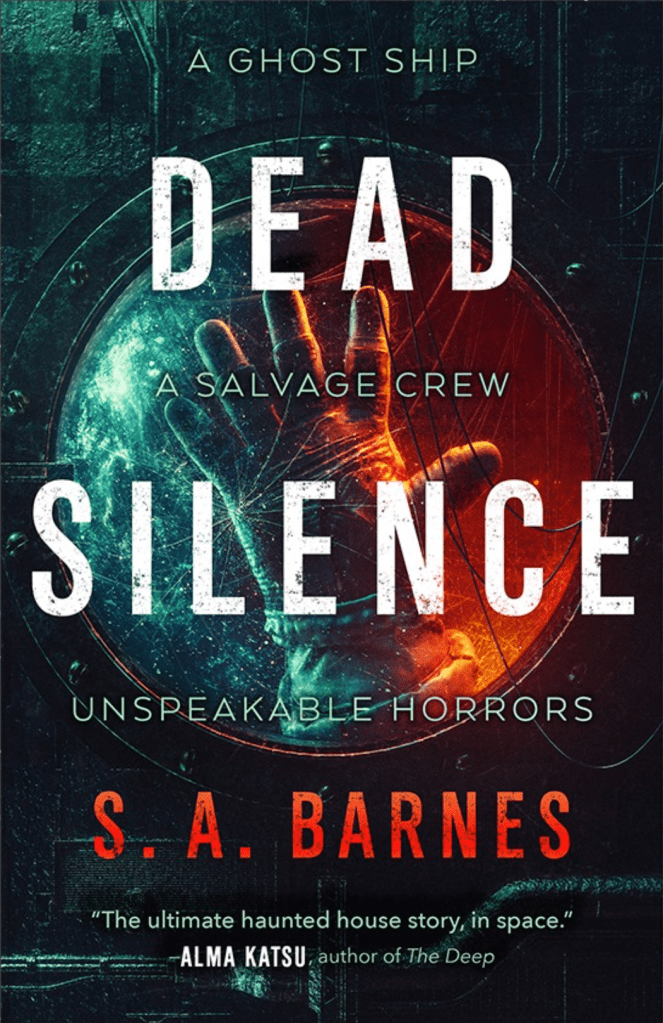
About a year ago, I also read the novel Dead Silence by S. A. Barnes which is a science fiction horror story. It also takes place in a very corporate-run setting, where digital technology is everywhere and there is an enormous wealth difference between the rich and the poor. In Dead Silence, these themes are engaged with in a somewhat deeper way, in my opinion. The protagonists explore a possibly haunted ghost ship in order to make money and escape their dead-end corporate lives. They are deep in debt, and every decision that they make has a price tag attached somewhere. It still has a lot of space opera elements: there’s limited FTL travel, artificial gravity, and the story could be told on Earth. The plot could absolutely be setting-swapped to the middle of the 20th century, and in my mind, that ability to be transplanted back to Earth is one of the key elements of space opera: the story isn’t about space, it just happens there.
Another recent deep-space cyberpunk novel is Dead Space by Kali Wallace, which I have referenced in a few of my blog posts. Dead Space is a murder mystery or thriller novel set on an asteroid in deep space, and it also features many of the same elements as the previously mentioned works. The protagonist is a cyborg who has been placed in indentured servitude with a corporation, and corporations effectively rule large chunks of the solar system. The corporations also work to keep everyone deeply in debt, and a lot of the novel is about the protagonist’s deep frustration with the corporate system, and her attempts to escape.
These books aren’t a sample of every single science fiction novel published in the last few years. I mostly choose books based on whether or not they sound silly and interesting based on the title and whatever is on the back of the book, and I believe that this tends to select for certain kinds of novels. But other books that I’ve read recently also have these themes, like Ymir by Rich Larson,The Third Rule of Time Travel by Philip Fracassi,and Paradise-1 by David Wellington.
Looking backwards into time, I believe that there is a pretty clear trend of works becoming more and more cyberpunk. The cyberpunk genre began in the late 60s, with the novel Stand on Zanzibar being the earliest strongly cyberpunk novel that I have read. It has all the expected parts, like corporate rule, advanced digital technology, dehumanization, and corporate exploitation, although it is clearly an early part of the genre. If one is interested, it’s possible to draw lines back even further, but the 60s is a reasonable starting point for consideration.
From the 60s to the 70s, these cyberpunk ideas were very niche, and not really codified into a specific coherent genre. A lot of strange ideas were circulating, and you can see that in works by writers like J. G. Ballard, who covered a lot of cyberpunk themes, often without the “cyber” part. These works didn’t have a specific overarching aesthetic and often had very different ideas about what corporate rule would look like. For example, in the aforementioned Stand on Zanzibar by John Brunner, corporate rule is depicted as a benevolent and competent alternative to traditional governments, and when a corporation takes over a small African country this is mostly depicted as a wise policy by the nation’s leadership (as well as a profitable one for the nation). Stand on Zanzibar still has many of the themes of corporate rule, computerization of everything, extreme wealth gaps, and the modification of the human being (albeit through mind editing and genetic engineering instead of cybernetic implants).

Then, in the early 80s, William Gibson wrote his influential Sprawl stories, starting with Johnny Mnemonic but most famously including the novel Neuromancer. These works did a lot to codify the aesthetic and details of cyberpunk. Everything is run by corporations, there’s high tech and cybernetic implants and people talk kind of funny and everyone is poor except for the extremely rich. The protagonists are people outside of the law, and they use super-stylized aesthetic hacking in a cyberspace that is incredibly immersive and pervasive, where a failed cyberattack means that your brain gets melted and where people hide out in capsule hotels holding onto “hot RAM”. It’s sleek and grungy and it’s in your face, and then the genre took off.

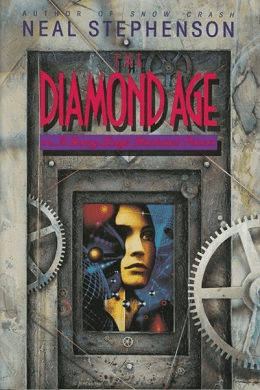
Throughout the 90s, the cyberpunk genre developed further. Neal Stephenson is the author that, in my mind, reached the pinnacle of what cyberpunk can be when he wrote Snow Crash and its quasi-sequel The Diamond Age. 1992’s Snow Crash plays everything straight—some political situation has led to the US balkanizing into a million corporate fiefdoms, where every laundromat, fast food chain, and church is its own country. It has the same super-stylized hacking from Neuromancer and a new global network, where people hang out in VR, and an extreme wealth gap where the protagonist lives in a storage unit with a roommate and billionaire megachurch pastors buy aircraft carriers with their own money.
Then The Diamond Age, from 1995, shows a world where corporations are no longer the dominant force, because the shattered countries of the world fused back together into ethno-cultural units, advanced technology complicated the idea of a wealth gap without erasing it, and the world is full of a combination of infinite possibility and deep oppression. It is less cyberpunk in some traditional senses—much more is made of Confucianism, nanotechnology, and race than of corporations, because it proposes a world where corporations have evolved into ethnostates, or maybe a world where ethnic ideas hijacked corporations for their own ends.
In my mind, these two novels mark a bit of a turning point in the 90s, when people started to approach cyberpunk in more diverse ways. S. Andrew Swann’s Hostile Takeover trilogy of short novels is about an anarchist planet where cyberpunk-style megacorporations are just one of the many strange organizations that exist.
Then, in the 00s, I believe that cyberpunk elements began to be incorporated into literature more broadly. That era saw a whole load of novels focusing on hyperintelligent AI and technological singularities, like Singularity Sky by Charles Stross, as well as military novels that incorporated some cyberpunk elements. I recently read Michael Z. Williamson’s The Weapon, which had many classic elements of cyberpunk on the planet Earth, but was more of a military science fiction novel about a handful of special forces soldiers fighting in conflicts broadly similar to the War on Terror.
Then, moving into the 2010s, we see a diversification of cyberpunk literature, with more and more novels starting to incorporate cyberpunk elements as digital life became more and more pervasive. In the 2010s, even literary fiction started to incorporate some elements of what could be called cyberpunk, with stories published in mainstream literary journals having strong elements of cyberpunk. This trend probably culminated in the early 20s. The novel that comes to mind for me is Patricia Lockwood’s No One Is Talking About This which is one half accelerationist cyberpunk nightmare about being plugged into and obsessed with social media and one half medical tragedy involving high technology. It’s also essentially autobiographical, describing Lockwood’s own personal struggles and the unfortunate death of her niece. It won many non-science-fiction awards and was nominated for the literary Booker Prize.
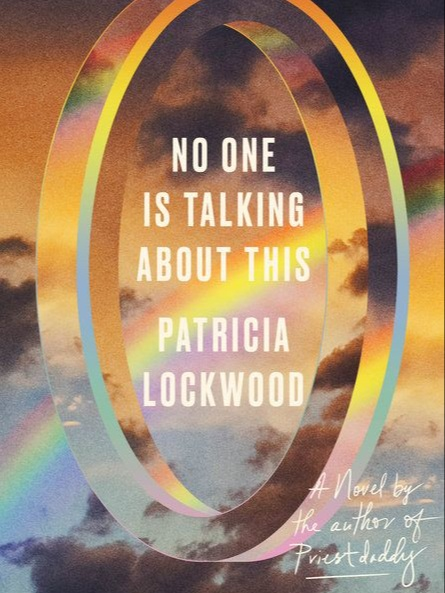
And I think that No One Is Talking About This makes it pretty clear why many works of science fiction have taken on cyberpunk elements. We live in a cyberpunk world.
People have usually said this in a political context, but regardless of how you feel about politics, most people will agree that we live in a world where large corporations and digital technology are incredibly important and dominate people’s lives. We are all constantly linked into the planetary internet through our smartphones in our pockets. We are constantly spied on by corporations and governments, endangered by cyberattacks, and more closely integrated with technology, even if it is outside of our bodies instead of inside of them.

It is also impossible, in my opinion, for many authors to imagine a future world that isn’t cyberpunk in some form. It is difficult for people to see a future world where digital technology can co-exist with democracy, where corporate influence is curbed without the government taking its place. What would a future look like where we have advanced digital technology still, but people aren’t always connected to the internet? What would a future look like where people have privacy, and equality, and independence? Or a future where institutions are local, and understandable?
I have read a lot of science fiction short stories that try to address these questions. There are “solarpunk” stories, which usually aren’t all that much about fighting the power so much as being in a nice pretty world where people are kind to each other and everything is alright. To find these, look for any fancy science fiction collection. I don’t enjoy them, but they are popular with some people and I do think it’s good to highlight ideas about positive futures.
I think that in some ways, the cyberpunk genre has gone from creative and forward-looking to stagnant and trapped in the present. In The Diamond Age, one of the major plot points is that an advanced teaching device is created for a character named Fiona, and later Amazon would use the codename “Fiona” for its Kindle project. Elon Musk’s Tesla is selling a “cybertruck” that looks like it would fit in Timecop, and mass surveillance has been a known fact of life since the middle of the 2010s. When we write about cyberpunk themes, we are barely looking into the future. We are looking more at an exaggerated present, one which may not even reflect the actual changes we are seeing in our society.

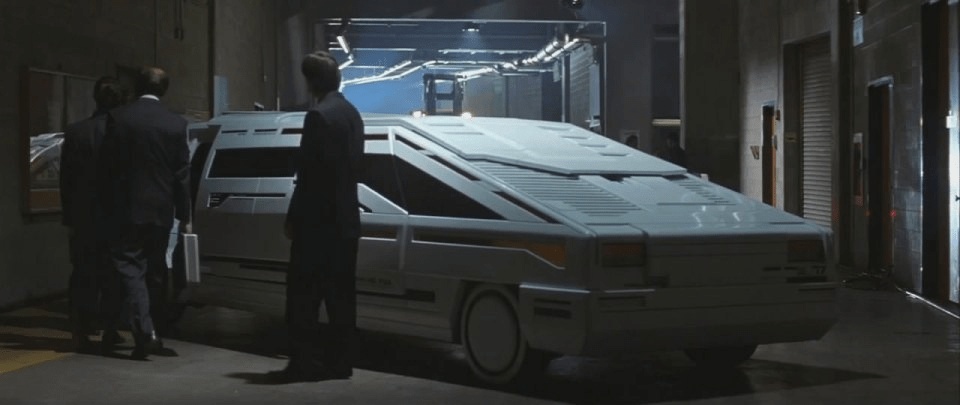
Although digital technology is more and more pervasive, and corporations control significant parts of everyday life, many people are resisting these trends, and sometimes even successfully. The government-bought-but-company-run Flock security cameras have gotten removed from some cities, and some people are choosing to unplug from the internet altogether while at the same time national firewalls seem ready to balkanize this global network into regional blocs. Certainly, we live in a cyberpunk present, but it seems unlikely that we will have a cyberpunk future, because for better or for worse, the technology surrounding us will change.
In the 00s there was a popular trend of writing novels set in a post-peak-oil apocalyptic future, like Paolo Bacigalupi’s Windup Girl or Julian Comstock by Robert Charles Wilson. This was obviously directly related to the anxieties of the day. Gas prices were high, and wars were being fought in oil-rich countries. There was a fear that oil would run out. And now, we live in a world where oil seems like it will never go away, no matter how much people want it to, and people are far more cognizant of the negative effects of its continued consumption.

Similar themes can be seen going back further into the past. John Brunner’s most famous literary output was dystopias he extrapolated from current technological and social trends: Stand on Zanzibar is about overpopulation, while The Sheep Look Up is about the overuse of toxic chemicals. George Orwell’s 1984 was written to criticize and extrapolate from rising Stalinism. H. G. Wells’s The Time Machine was based on rising economic inequality. And we live in a world without Morlocks or Oceania or General Technics buying a small African country or the whole US going up in flames, because the social trends that these works were based on did not continue indefinitely.
I believe that the “cyberpunk trend” we have seen at the beginning of the 21st century will not continue forever, and in my writing I have been trying to avoid assuming that the future will be cyberpunk. But, whatever form the future takes, if it is our future, it will be a future built on top of a cyberpunk past.
 J. E. Landau
Leave a comment