As part of a project I have been doing research for, I recently did a bit of reading into the Toba catastrophe hypothesis. The theory goes that, at one point, the human population was fairly large and spread out into several parts of Eurasia, but then the eruption of the Toba supervolcano 74,000 years ago led to the near-extinction of human life, possibly down to a few thousand people. This population then consolidated, expanded, and grew out of Africa again, repopulating the areas that had once developed human life.
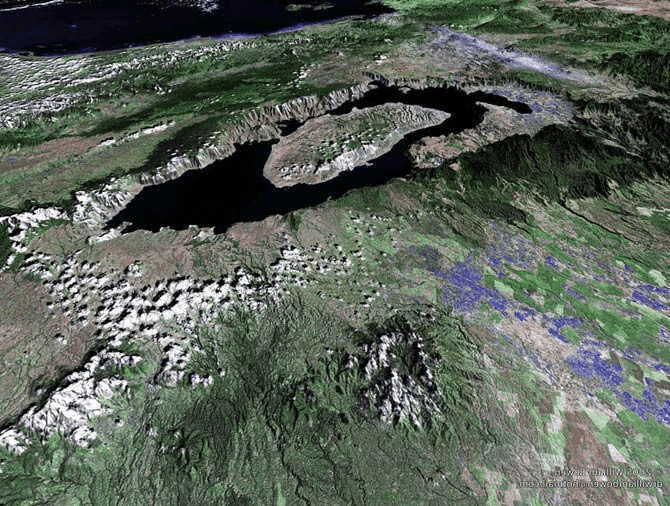
Now, this theory is controversial among scientists for a lot of reasons, but it is interesting, like a lot of apocalyptic scenarios. I imagine lost peoples, languages that disappeared completely, entire missing segments of art and life that have been lost forever, buried beneath volcanic ash, tens of thousands of years ago…
As a science fiction writer, my mind wants to imagine some sort of lost advanced society that collapsed after the apocalyptic supervolcano eruption, but obviously there are reasons why this would not be the case. The more advanced that societies become, the more they tend to leave behind significant material remnants. Not just pyramids and temples like we commonly think of, but damages to the environment, chemicals released into the atmosphere, new forms of life like domesticated crop plants. And very few remains from those mysterious peoples have been found—remnants of ancient skeletons, matching no modern ethnic groups. Additionally, a very technologically sophisticated society would likely be able to weather a supervolcano eruption.
Of course, as science fiction fans and authors, that doesn’t have to stop us. Perhaps our hypothetical Lemurians evacuated into deep space, or, knowing that their civilization was doomed, made enormous efforts to restore the planet for future generations. This does raise the question of how they were not able to save themselves, but perhaps they had alternative technologies. The tabletop roleplaying game Continuum is themed around time travel, and one of the phenomena in the setting is very very ancient human civilizations existing in the time of the green Sahara from about 14,500 to 6000 years ago (surprisingly recent!) or even further back, tens of thousands of years in the past. In Continuum, the absence of any archaeological evidence of these civilizations is explained by a very thorough effort by time traveler society to erase evidence of these civilizations and preserve history as we know it today—a history that has been created almost entirely by the time travelers themselves! Additionally, in Continuum, most highly advanced technology is very small, and manifests in the form of psychic powers and other things that do not leave behind much of a material culture.
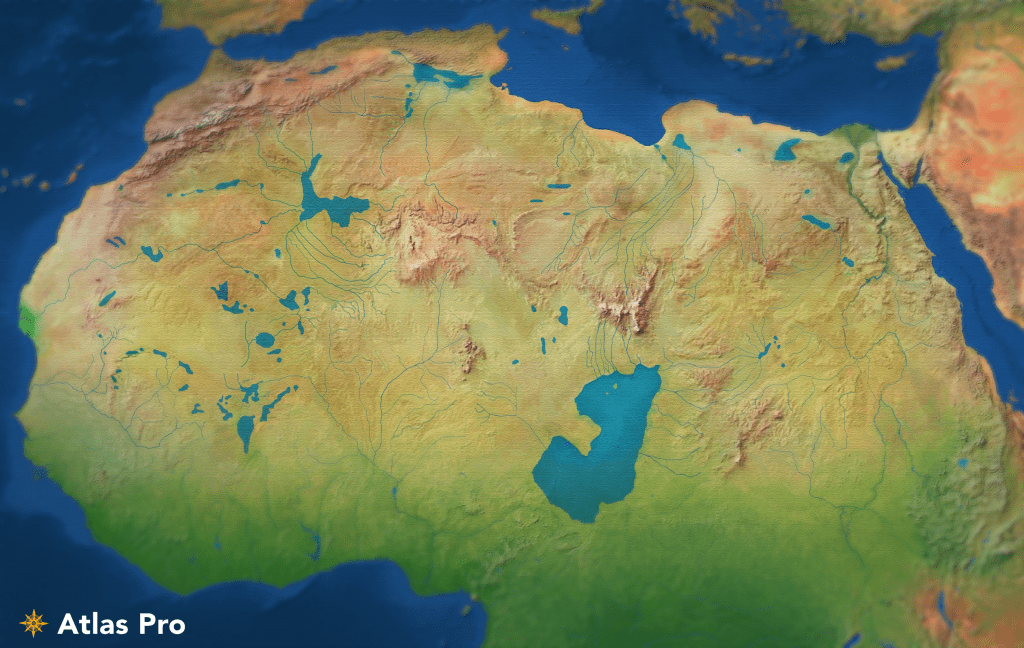
In a more grounded point of view, one could imagine some sort of pastoral civilization, or even an agricultural one flourishing in those regions long ago. But it seems unlikely. Even the earliest societies left behind a wealth of potsherds, bones, and other signs of their presence, which are not seen today.
But still, I wonder about those peoples. What artifacts did they leave behind? What philosophical ideas could they have shared with us? Barring the invention of time travel, we will never know.
The idea can be expanded past our real ancient history into the future. One occasional trope in more pessimistic science fiction is that humanity is able to colonize other planets, but these planets are never fully independent of Earth’s infrastructure. This is implied in the film version of Aniara with the Mars colony seeming to be desolate, and nothing being heard from it (or any human civilization) after a certain time, but it’s explored in more detail in Adrian Tchaikovsky’s Children of Time and Isaac Asimov’s Foundation.
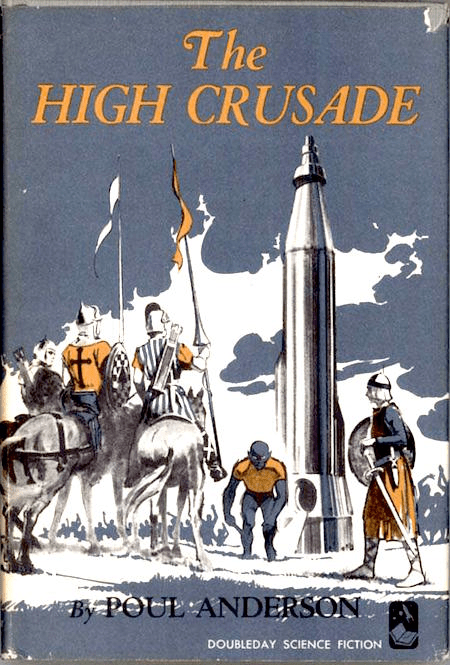
Foundation, which I have discussed here before, is a classic science fiction novel about predicting the collapse of civilization and working hard to establish a plan to ensure that advanced technologies will survive, and to try to prevent a long dark age after the apocalypse. One thing that’s mentioned a lot in Foundation is that many worlds are terminally dependent on the larger system of the galactic empire that exists at the story’s start. Once it begins to seriously collapse, the planets begin to run into serious trouble. The novel begins by talking about Trantor, the capital of the empire, as needing constant food imports just to keep everyone alive. During the collapse, many colonies lose their advanced technology, some going back to a feudal state and nearly all of them losing their nuclear technologies. The titular Foundation is then able to exert its will over these futuristic space-barbarians, giving the scientific institute space to survive.
Children of Time is a contemporary novel where human civilization collapses due to an elaborate terrorist attack taking out computers all across human civilization. Many worlds were colonized, but without interstellar trade and all their earlier technology, they are wiped out completely. Human civilization does survive on Earth, but only on top of a pile of bones, and much of the novel’s plot involves the last few humans traveling on an enormous colony ship to try and find a terraformed world. Along the way, they come across many remnants of human civilization, all much more advanced.
Neither of these works is interested in these fallen civilizations in a cultural way. They are merely sources of technology and conflict, but nothing is explored in terms of their actual lived experiences, what it was like to be a member of one of these doomed groups. I can think of a few games, both computer and tabletop, that deal with this theme, but unfortunately I haven’t seen it represented much in literature.
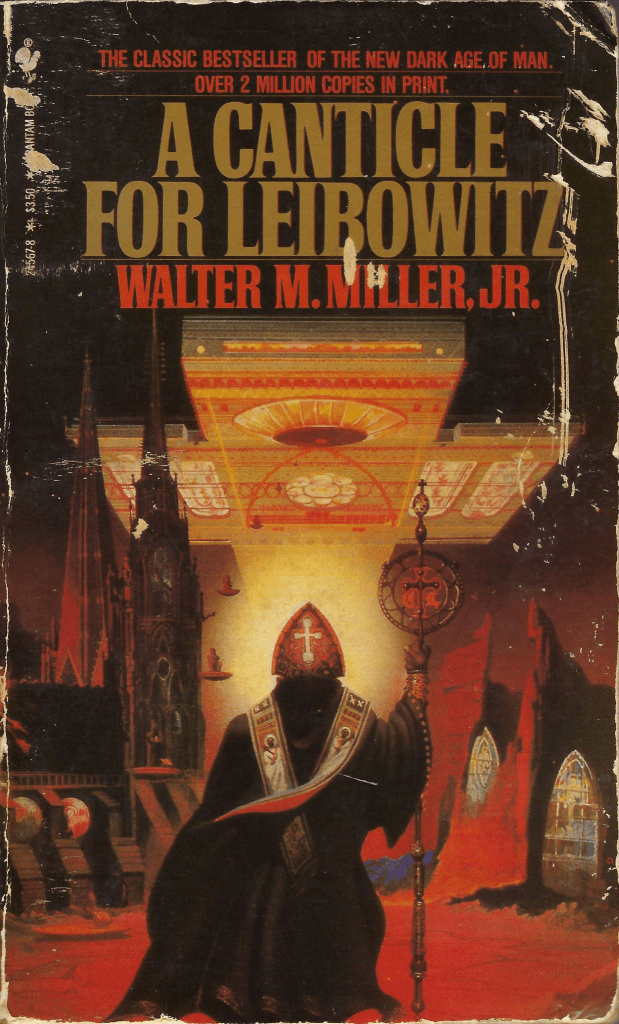
Some of my favorite post-apocalyptic novels, like Julian Comstock and A Canticle for Leibowitz, spend some time talking about post-apocalyptic cultures, but mostly in the context of social criticism. The societies they show there are reflections of our own, like any fictional societies, but it does feel like a bit of a missed opportunity. How would our cultural and social institutions develop, if the level of technology were to decrease? How would people handle life without the internet, without electricity, without cars?
And, beyond that, how would people handle really being bombed back to the stone age? What would it be like if some separate human population was reduced beyond even the medieval level, down to the point of forgetting how to do agriculture and becoming hunter-gatherers again. How would their culture develop?
One thing to note is that a hunter-gatherer society may struggle to keep long-term records. This is because they do not have the industrial base to produce paper, parchment, papyrus, computers, etc., but there are definitely ways to overcome this. Quipu and bead-based writing systems would allow for records to be kept without the ability to produce any traditional writing surfaces. There are still significant limitations, since a record-keeper can only carry so many writing strings, and keeping them organized may prove difficult.
This might seem like a small detail to worry about, but the loss of writing means that it is difficult to transmit culture that isn’t popular with every generation. If, for example, we stopped caring about Shakespeare for 100 years, and then came back to the Bard, we would easily be able to look through his works because they are written down. Oral traditions can do a great job of transmitting information between generations but they do require each generation to make active efforts to learn and then teach the stories. This means that these societies would only be able to support a more limited set of myths.

Similarly, the smaller size of a hunter-gatherer group is an obstacle to transmission of a variety of myths. Individual people can only care about so many things, and even if a society has dedicated record-keepers to hold onto myths those record-keepers are themselves limited, and each record-keeper will have specific preferences. A small pre-agrarian society simply cannot spare the labor to hold onto so many stories.
Because of this, I think that you would see a lot of distillation of the values and ideas of a people. I read The Network State by Balaji Srinivasan which is a ridiculous anarcho-capitalist rant against wokeism and cancel culture, but one very silly thing that Srinivasan says is that a Pittsburgh Steelers fan’s primary identity is as a Steelers fan. While this is probably true for some, it is unlikely to be true for most cases. The decreased number of identities that can be supported after a social collapse, however, could lead for sports teams to take on a new totemic significance. Relatively arbitrary pieces of social identity could become core.
This is not to say that hunter-gatherer cultures are simple. In fact, they are often more complex. Languages that are spoken by smaller populations tend to have more complex grammar and syntax, although their vocabularies are also usually smaller. They often have unusual features that are particular to that group, and their phonologies tend to be very complex.
Similarly, smaller social units are able to have more complex rituals, more complex rules governing social interactions. This is because it is easier to teach these things to a small group, and you have a more focused set of people when you introduce new people to your culture. Think of your family’s in-jokes, and the in-jokes of your friends. They can be very elaborate, but these displays are hard to continue in a wider group. And imagine if there was no larger group!
Taken to the extreme, I think it would be fascinating to see micro-cultures of just handfuls of people in a post-scarcity societies with lower technology—for example, in an engineered environment which they could not control. Their social rules could be incredibly elaborate and strange, isolated in deep space. We cannot see the distant past, but we can imagine it, and the distant future. And in the future, we have more to work with, since we can extrapolate from the present and build upon it.
 J. E. Landau
Leave a comment