
I, personally, do not believe in psychic powers. Although there have been a few odd studies that seemed to show evidence of telepathy or ESP, there is no serious evidence that people are able to read each other’s minds, send their thoughts, look at far-away phenomena, or control the actions of others. Except in the normal ways that all of those things are possible, of course. But this has not stopped various world governments from going in on the research of these subjects.
Some of my readers my be familiar with Jim Channon, whose military psychic experts were described in the popular book The Men Who Stare at Goats, which talks about what it calls “Project Jedi Warrior” and various US military attempts to study paranormal and psychic phenomena.
Many of the things discussed in that book are not known to be real. For example, the eponymous US Special Forces instructor who was able to kill a goat by staring at it, or the various generals who allegedly oversaw the parapsychological research that the book describes.
Jim Channon, however, was absolutely real. He was a real Lieutenant Colonel (which seems to be the perfect rank to write off-color military literature, for whatever reason) and he was a woo-woo New Age business consultant after he retired from his Army career. He was also involved in the release of something called the First Earth Battalion Field Manual (available here), which is a real delight.
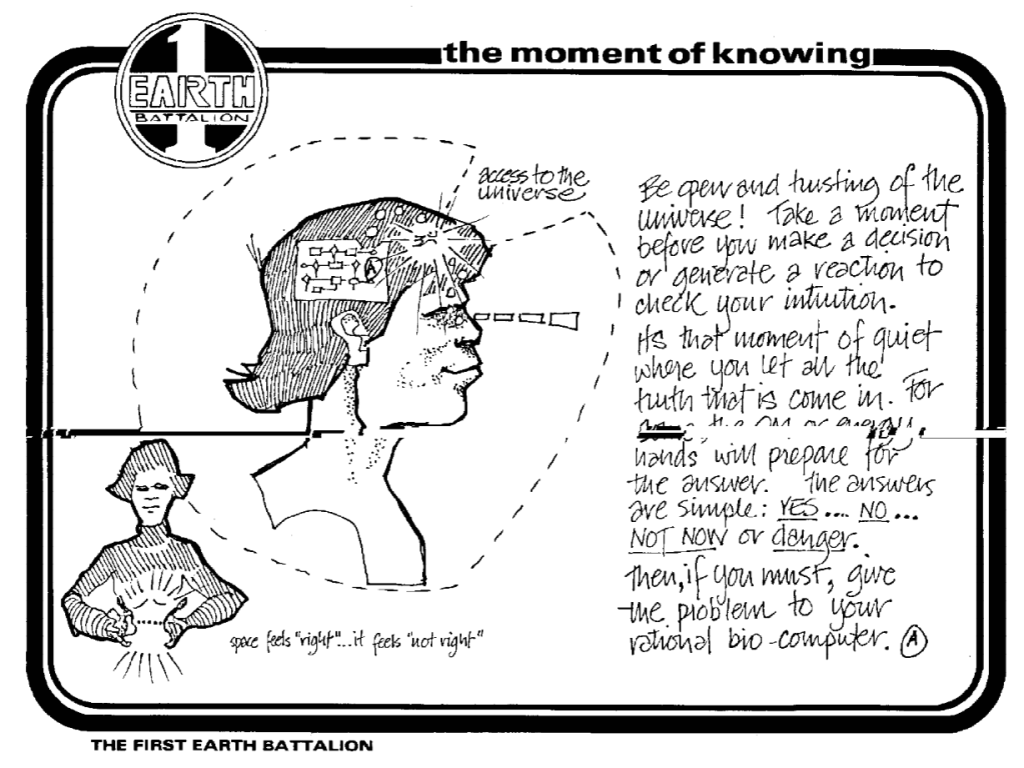
It includes a whole range of strange illustrations and outlines potential missions for the First Earth Battalion. It suggests resolving something like the Iran hostage crisis by having members of the First Earth Battalion (FEB, my acronym) exchange themselves for the hostages. On the other hand, if there are purely ideological hostage-takers, the FEB would naturally perform a “commando strike (if politically feasible)”. The manual proposes having the soldiers broadcast themselves lined up between armies waiting to attack, carrying dowsing rods and crystals into battle, and achieving maximum lethality through enlightenment.
There is a strange, new-age-futurist hybrid ethos that pervades the work. “Armies are both the potential instruments of our destruction,” the manual says, “and the organized service that can drive humanity’s potential development… We have no choice but to encourage world armies to accept and express the nobility they already strive to attain.” The book exalts soldiers and militarism but also declares that “strategic objectives now include protecting cities. Tactical actions now include the projection of love and concern. The door is opened for joint US and Soviet cooperation.” The Channonian supersoldier is lethal, pure of mind, and well-intentioned, ready for war on both the psychic and material battlefront.
Of course, the FEB did not come to be. But there are tantalizing traces of its extension throughout the army. The original FEB Operations Manual precursor paper, published 1979 (archived here), is endorsed by a Colonel D. M. Malone, although his name does not appear on the 1982 complete manual. Colonel Malone was apparently very influential in the US army, but I have found no evidence that he was involved in parapsychology research beyond his association with Channon. I’d be interested in hearing more from anyone who knows more about the man and can give information on any involvement (or lack thereof).
Channon’s manual also references Major-General Boney Fuller, “the father of mechanized warfare” (according to Channon), but he was a British general, and his involvement in the occult is well known, along with association with fascism. Fuller was, however, more of a Thelemite, and I don’t think that his philosophy is especially connected with Channon’s thinking. In my mind, Channon’s work is part of a greater body of New Age spirituality that derives from much Eastern philosophy, although I am not extremely familiar with Thelema and may be unaware of important connections there. Occultism has never been a super large world, so it’s likely that Channon drew from many sources, but I don’t believe that Thelemite thinking has been majorly influential in the military.

Even if Channon’s thought didn’t spread, it wasn’t the only substantiated case of the US government investigating parapsychological phenomena. The Stargate Project, probably-not-coincidentally also started in the late 70s, is also covered in The Men Who Stare At Goats, and it was overseen by a Major General John Stubblebine, who was interested in psychic phenomena.
The Stargate Project attempted to use remote viewing and other psychic means to gain actionable intelligence, although The Men Who Stare At Goats associates it with attempts to create psychic supersoldiers. It ran for 18 years, and afterwards most people agreed it didn’t find anything, although it wasn’t that big of a project. It did involve a few famous TV psychics, like Uri Geller, and it is no doubt a major feather in his cap.
Stubblebine, for his part, continued to be a true believer. To my knowledge, there are no serious attempts in the US to use psychic powers for military purposes but it wouldn’t surprise me if there were a couple dozen researchers squirreled away in a few intelligence agencies trying stuff just for the sake of thoroughness.
The Soviets were serious about their own psychic research programs. Earlier this year I read Homo Sovieticus, by Wladimir Velminski which describes a fair bit of Soviet psychotronic and parapsychological research. Compared to the US, much of it was begun in an earlier era, with Aleksei Gastev leading such research in the very early days of the Soviet Union, albeit on a small and very theoretical scale, discussing mind control in the context of industrial management and worker training—not what we would consider mind control, perhaps, but there are discussions of “[synchronizing] the processes of steering and regulation with all attendant settings… so the ensemble would bear the imprint of well defined regularity. As a corollary, new modes of thinking would arise from the template now in place.”
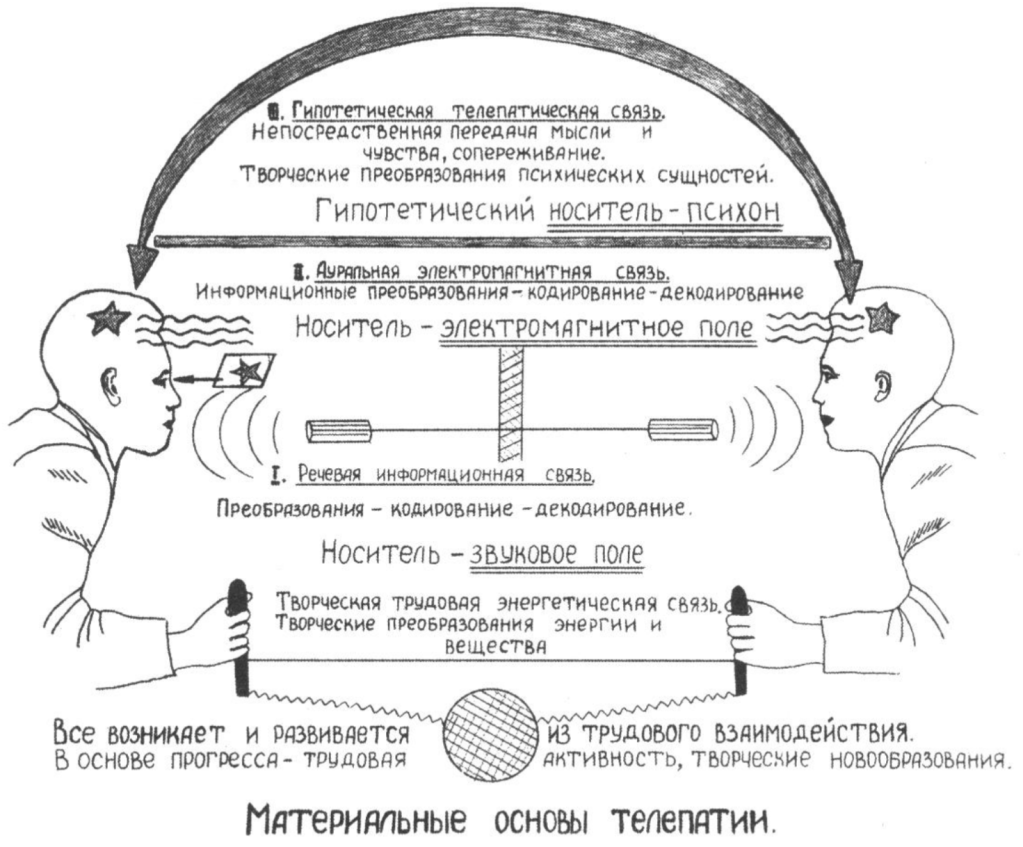
The book details how Soviet thinkers, ranging from science fiction authors to government researchers, hoped to use scientific means to control people’s minds and enable telepathic communication for various purposes. It also details a number of bizarre diagrams from that time. One figure that is mentioned is Vladimir Durov, a dog trainer who could allegedly get his dogs to move by mental command, which seems rather implausible. I blame the Clever Hans effect, although Welminski does not attempt to explain it himself.
There are a lot of discussions of Soviet science fiction discussing the electrical radiation of thought being captured and controlled, or researchers looking at doing so in real life!
There are also some later discussions of Soviet bioenergetics research in the 60s, which does feel a bit like Western woo. Specifically, one Soviet columnist discussed electronic diagnosis “in a few seconds”, based on some sort of “electrotonic field”. Similar ideas have been covered in the West with biofeedback devices and aura reading. Some of these researches take on a more spiritual dimension, with the Psychotronics researcher Gulyayev believing that he can photograph the soul in these aura readings. These results were also debunked with further research.
Most of these research efforts are relatively early in the life of the Soviet Union and the 20th Century in general, and the theoretical underpinnings are more based in early psychology and physical sciences instead of New Age thought. The book does, however, discuss a curious case:
In 1989, as the Berlin wall fell, the energy healer and hypnotist Anatoliy Kashpirovskiy was broadcast across the Soviet Union, attempting to calm the Soviet public and induce them not to revolt during the throes of Perestroika. Of course, things did not turn out to plan. But the Soviet fascination with hypnosis is found throughout the book’s description of the history of Soviet psychotronics research. It was believed that the Soviets would have a “society suffused with electromagnetic waves” in which “it was only a matter of time before society would no longer have to depend on wires to hear Moscow speak,” as far back as the Lenin era.

Unfortunately, I am not fluent enough in Russian to trace the people mentioned in the book further through history, and they are not well documented in the Anglophone world. I am sure, however, that there were military psychotronics researchers and equivalent figures to Channon, and there are no doubt modern Russian mystics who carry on the legacy of Cold War era Soviet work.
In this way, the Americans really were playing catch-up to the Soviets. While some Americans, like Channon, thought that a government-directed psychic revolution could change the world, they were far behind their equivalent Soviet thinkers, who were saying the same things in the 20s! Of course, part of this is likely a difference in political ideology. For an American, the idea of the government controlling and directing the thoughts of the people would likely have been horrifying, while the Soviets probably would largely not have been comfortable with such things in general, but radical thinkers like Gastev likely would have accepted this level of psychic connection.
This is not to say that the reasons for developing parapsychological technology were purely ideological in nature. I can’t find the attribution now, but I’ve read a couple quotes along the lines of: “the Cold War was spent trying very hard to find a way to kill a few hundred million people in an instant.”
There are a number of intuitive military uses for psychic powers. One could, for instance, mind control a missileman, or a foreign leader, or convince armies to lay down their guns or fly into a fanatical rage. Of course, there are conventional ways of doing all these things, but they are notoriously unreliable. For example, hypnosis and mind control are real (although unrelated!) and it’s not clear how well they work. Propaganda is already used to motivate troops in a conventional way, and to try and control foreign nations. Doing any of these more strongly with telepathy would be an upgrade. So much of military training, according to the controversially-true book On Killing, is designed to reshape a recruit into a person that can kill, and further indoctrination is needed to create the type of person who can turn a key and doom the world (although I believe that Curtis-LeMay-level nuclear warriors are probably naturally inclined).
Telepathic powers could also have a number of applications specifically for nuclear warfare. For example, you could use remote viewing to find missile bases or nuclear submarines, or look inside of nuclear warplans. You could perhaps use some form of suggestion to force your nuclear warfighters to actual fight the nuclear war. If necessary.
Of course, there are a whole host of civilian applications, and people still turn to popular psychics for these today. It is not my place to say what is legitimate and what is not, exactly, but it is clear to see that the Soviet idea of bioenergetic medicine is connected with modern faith healing and that Channon-esque spiritual warfare is similar to mystical martial arts.

I have been thinking about the use of psychic powers in science fiction, and right now it seems like they mostly take the place of more fantastical magic systems. They are sometimes used for social control, like in Babylon 5, or they can be explored more deeply like in the work of Alfred Bester (referenced in Babylon 5)who wrote the Demolished Man, where psychic powers are explored in detail. To build on this past work,I think it would be interesting to consider their more spiritual implications.
For example, if psychic powers can really photograph the soul, does this mean that you could objectively determine if people are evil? Who decides this? It’s pretty common for people to talk about psychic powers in the context of reincarnation or a global shared mind or spiritual connection, but what if ideas can spread between people by traveling through the shared mind, instead of reincarnation? Or what if diseases can afflict the soul or the noosphere?
In a lot of psychic literature, the psychic must be pure of soul or enlightened or something similar, and this sort of initiation is sometimes discussed in fiction but is often skipped. For example, the telepaths in the two pieces of media mentioned earlier are simply people with a natural aptitude that has been trained through practice. What if becoming telepathic required you to be a good person? Or just an enlightened one? The latter is more common, as having cosmic good and evil is a bit out of fashion in fiction and can lead to unfortunate implications, but it might be cool to have a setting where psychics claim that you have to be a good person, but you simply need to meditate really hard.
It could also be cool to have psychics completely eliminating privacy in a society, if remote viewing is possible, which could be a good analogy for today’s technological surveillance state. Perhaps these concepts are combined—telepaths know if you’re a bad person, no matter where you are, or what you’re doing!
I’d also be interested in seeing psychic societies closer to the Soviet vision of telepathy, where people live in a bath of government-sponsored telepathic radiation. I imagine that would be either very comforting or maddening, and it could look like a proto-hive-mind. Or maybe just the dream advertising from Futurama, which could be horrific and pervasive. I’m certain that some classic science fiction author covered that topic before.
In any case, the real-life history of psychic research is actually very strange, and I hope that it will be good fuel for writing, including my own. I have been thinking about some of these ideas for a future project, albeit one that I don’t expect to be working on for a little while.


 J. E. Landau
Leave a reply to mickgord Cancel reply