I might talk about Greg Egan too much, but he’s had a lot of interesting ideas. Somewhat recently, I read the book Permutation City based on the recommendation of a few acquaintances, and I really enjoyed it, but I think that the book has a fundamental philosophical problem, which I will attempt to explain here. I am going to be spoiling the hell out of the book, so if you’re worried about that, I really wouldn’t recommend reading further, although I’m not usually very good about spoiler warnings on this blog at all.
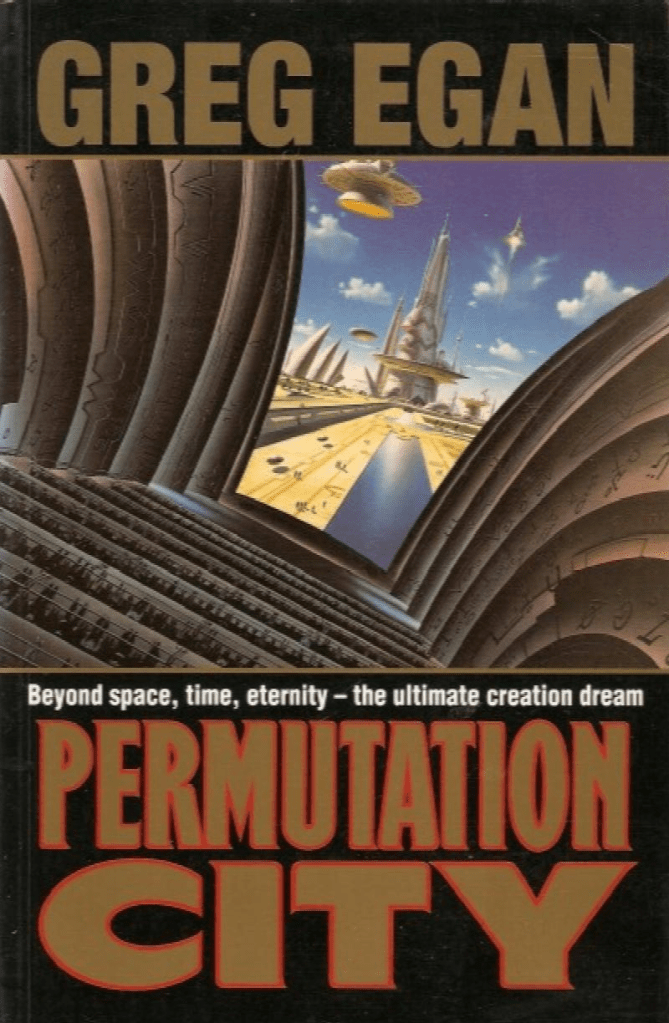
Permutation City is set in the near future, when the world is suffering from a climate crisis, and computers are all linked together so that most computation is done by renting time off of public supercomputers. Brain uploading has become possible, but it is very expensive, and copies of people need to rent computer time from the world internet to run. Even then, people can only run at up to one-seventeenth of the speed of the public, while some poorer virtualized people are only able to run at very low speeds, hundredths or less of the speed that the general population is able to operate at.
In this future, many kinds of self-modification are possible, and some digital people, for example, spend all of their time in pleasant simulations, including modifying their own perceptions so that they enjoy repeatedly climbing a building. Other uploads choose to experience recreations of ordinary life or spend time in shared simulated spaces with other uploads and some members of the public. But one of the most interesting cases is the protagonist, a man named Paul Durham, who experiments on an uploaded copy of himself.
Of course, as soon as he’s uploaded, he panics, thinking about all the things around him, and immediately tries to turn the simulation off, something which the meatspace version of Durham has prevented. This, of course, raises the question of whether or not this is ethical, and there are the usual brain uploading questions of whether or not an uploaded person is a real person and how morally distinct they are from their original copy, so I think that we should take a small pause to contemplate these questions.
It is, of course, impossible to prove that an uploaded person is a real person, or that they are the same as the original person. Recently, there has been some kerfuffle about whether or not existing artificial intelligence products can be people, and I do not believe that they can. My reasons for this are varied and probably too long to fit into this blog post, but the fact that current artificial intelligence does not qualify for personhood (which is already a nebulous quality, and one which has been criticized) does not, in my opinion, preclude the possibility of future computerized intelligence.
It’s fairly easy to conclude that a virtual copy of a person is also a person, although whether or not they are the same person is a different question. This does require that we assume that a person is a material thing, so everything inside of a person can be described using the laws of physics, which is not a premise that everyone will be willing to accept. After all, many religious groups believe in immortal souls, which might be required to be a person, and so if this soul is essential to personhood and not able to be captured or duplicated by a computerized reproduction of a person, this would disqualify that replica from personhood. If, however, we accept a non-dualistic interpretation of personhood, where the things that make you a person are included as some subset of your body, then this premise must stand.
From there, it is easy to see that it is theoretically possible to simulate every part of this body on the computer, and so it is also possible to simulate any subset of this body. This would be very difficult, as has been seen with attempts to run simplified models of the human brain which have used enormous supercomputers with thousands of GPUs. We don’t yet know enough about the brain’s functioning to simulate the neural function of simpler organisms and a lot of these challenges have been discussed in detail in the State of Brain Emulation Report. Of course, it is possible that we will need to emulate much more than the brain, like for example there is some evidence that the gut microbiome plays a significant role in cognition but that simply increases the scope of what you might have to emulate. If “personhood” can be captured fully materially, it can be simulated. Thus, if we are materialists, we must accept that uploaded people are people.
Then, there is the question of whether or not the uploaded person is the same person as the original, and I think so, but this is more of a question of philosophy that is not easily dealt with, and I think that there are a variety of well-thought out perspectives on the subject. But for the argument I’m about to make is not whether or not an uploaded person is the same person as they were before the original, but whether or not you can duplicate uploaded people.
Let’s say that you have been copied onto a computer, and, in fact, the original version of you no longer exists for whatever reason. So “you” are, whatever you are, that computer version. Now, what happens if the compute running you stops that simulation, and then resumes it later? From your perspective, nothing will have changed. In fact, no time will have passed for you, if this pause-and-resume practice is “pure”, just like how no time passes between instants in the real world. In fact, there are some physical theories that posit that spacetime might be discrete instead of continuous.
This opens the possibility of moving this brain around to new hardware. After all, if the personhood is the program, and you can stop and start it freely, without interrupting that personhood, then why shouldn’t the same personhood be run on different machines? You pause on your home computer, swap out a bunch of the parts, and then start running again, and you wouldn’t feel it, although it might change how outside inputs are processed.
And, getting back to our original subject, Permutation City’s Paul Durham performs exactly these experiments. He slows down his perception of time, he has the computer run certain simplifications out of order, he speeds things up. He messes with geography, including spreading out his brain around the world—noting that, with his brain’s computation spread to computers on every continent, “he didn’t feel much like a digital Gaia, though. He felt exactly like a human being sitting in a room a few meters wide.” Changing the means of computation and the hardware the computation is performed on does not have to change his perspective.
Now, this is, of course, a work of fiction, and in reality there are some reasons why this might mess with your perspective. Spreading out your brain so widely could cause perceptible lag that influences the way you think, for example, and it’s not clear to me that it would be possible to run the time steps out of order in the way that Egan depicts, just for technological reasons, but I do think that there is nothing logically incoherent about this. After all, the digital simulation steps are configurations of data. Do they need to be run in order?
In real life, our explanation of time is largely linear, but there is some evidence that people’s perceptions are influenced by phenomena that occur after those perceptions which is to say that to some extent our bodies construct narratives of the past.
More disturbingly, the only way that we can know what has happened, and understand our past experiences, is by consulting memory, which may be unreliable. So, if my experiences happen out of order, but in my memory they are ordered properly, this cannot be distinguished from reality. Think about times that you’ve told your friend, “oh, I went to the movie theater with you before that one big storm”, and you really do believe it. And then they inform you that no, the storm was before the time you went to the movie theater, and then they prove it. In the absence of reference to the outside world, you would never be able to determine that your simulation was happening out of order. For a simulated person, living in an isolated, simulated world, there is no practical difference between what you (and the world) think has happened, and what has actually happened.
Now, back to Permutation City. Armed with this knowledge, Paul Durham promises all the world’s wealthy uploads that he can guarantee them real immortality, with no worries about being out-bid on the world computation market or kicked out by an angry public. To do this, he constructs a complex, six-dimensional game-of-life model, which will reproduce all the data of his clients, and which can only be a starting state of the game, or a Garden-of-Eden configuration. Now, this is not exactly right but it’s immaterial to the point that is made.
They splurge on buying a whole ton of computer capacity, and they run the simulation. The game-of-life goes, and it gets larger, and it unpacks the simulation of Paul Durham in the computer, and he gives the thumbs up, and then they shut the simulation off, and delete it altogether. There is some additional drama in the real world, and it’s implied that Durham didn’t actually do any of the experiments mentioned earlier—he was suffering from psychosis, and merely thought that he did, feeling the fear of the copy without ever being uploaded into the computer. He kills himself, and it’s unclear if he will live again in the simulation, which has now stopped.
But, the simulation continues. Even though nothing continues in the real world, the simulation keeps running, because the states occur, randomly, throughout the universe. After all, there is nothing saying that the states have to be in order when they occur in the real world, they just have to seem in order within the simulation, and each state that is “next” in the order includes its own history, even if it is imagined. So the simulation continues as random arrangements of dust in the universe, hence the name, “Dust Theory”.
The simulation as depicted in the story continues for a while, and some points are made about human nature, and eventually it breaks down, for reasons that the theory as described would not include.
Except that’s not exactly true. Dust Theory is logically sound, and in fact, it’s almost exactly like a different theory, that of the Boltzmann Brain. The Boltzmann brain is a spontaneous arrangement of matter or energy or spacetime that encodes a person, with beliefs about the universe, sensory details, and thoughts. It would have no way of knowing that it is a Boltzmann brain, and it would “stop existing” instantly. Except, of course, that random chance would eventually lead to the next “frame” of the Boltzmann brain existing, and so this Boltzmann brain could live out a whole life.
Similarly, the simulation in Dust Theory works by the same method. The computerized simulation’s steps randomly appear in the variation of the universe, and they don’t have to appear in order, or in any one place. The pattern of the simulation simply needs to exist, for some instant. And it doesn’t need to all exist at once. After all, much of computer data need not be stored all at once. Do you remember when video games came on multiple disks? The same data could be spread out, fragmented. In fact, the universe could probably be read in multiple ways, containing multiple patterns.
It might seem like a big leap to make, but consider, how does it differ from the consciousness of someone in a computer? The data there is more readable, but it is still just data, and that data can be paused and restarted, reordered, slowed down or sped up, and geographically moved or dispersed. You could even encrypt and decrypt the data at each step, to make it unreadable, similar to the apparently random phenomena in the universe.
So, everything is good for Dust Theory, right?
Wrong. The real problem with Dust Theory is that from one state to another, there is no requirement for things to causal at all. Each step of the simulation is correlated with the ones before it by memory, and the people in it believe that they are in a real simulation with causality, but there is no need for there to be causality at all, and no force to create it. Nothing happens because of anything else, there are just different frames that might believe that they are connected with one another. Greg Egan himself notes this in his Q&A for Permutation City. Which does, in my opinion go a long way to explain the end of the novel.
How does the eponymous city finally break down? It breaks down once aliens evolved in a different game-of-life simulation “disprove” the existence of the simulation outside of it. Suddenly everything disintegrates, for no apparent reason, and no obeying any clear rules. This might seem incoherent, and it is.
But this is because, for a Boltzmann brain or Boltzmann simulation, there is no causality. Any moment can be succeeded by another moment. Your birthday might turn into literal Hell, or the world might suddenly turn into spacetime around you while you’re taking a stroll in Permutation City. In fact, this will happen, if the universe contains enough randomness to sustain it, and given that these representations can be encoded in completely obtuse manners, and can even be bigger than the rest of the universe, it certainly does, and so every possible permutation of the city would occur. Parallel to the world where the city disintegrates due to the simulation breaking down, there are worlds where it keeps working forever, and others where it just instantly stops. All possible things happen under this theory, and all possible things have already happened.
In fact, the initial “ritual” with the computer, the simulation, and the “we’re all good in here” signal is completely unnecessary, as Egan says in the Q&A. The city is self-consistent, and so it already exists, and has been described in every possible configuration, before Durham even begins his experiments.
And this reasoning, frighteningly, can be carried into the real world. Boltzmann was somewhat concerned by the fact that it is more likely that you are a Boltzmann brain, thinking you experience the real world, with a bunch of memories that don’t correspond to anything “real”, than that the world is exactly as you experience it. After all, if there are infinitely (or near-infinitely) many configurations of simulated worlds and consciousnesses, some of them are indistinguishable from you, right now, sitting and reading this blog post. For most of them, the next frame of reality they experience will be incomprehensible and have nothing to do with what they have experienced so far. Just like that, they disintegrate.
Of course, so far, in my life, I believe that everything has been driven by causality. And you can do something like Pascal’s wager. If causality doesn’t work, then nothing you do can influence what will happen next. On the other hand, if it does work, what you do does matter, and you can improve things for yourself by making certain decisions. So it is best to act as if causality is real and you are experiencing it, even if it is unlikely that this is the case.
So, as usual, with a lot of this existential stuff about the nature of reality, just keep calm and carry on.
 J. E. Landau
Leave a comment