I was recently gifted a copy of No Frills Book: Science Fiction, Complete with Everything: Aliens, Giant Ants, Space Cadets, Robots, One Plucky Girl. [their punctuation] which is a hell of a title. It’s a very strange, generic looking book, it’s less than 60 pages, its writing style is appropriately no-frills, and it took me less than half an hour to read.
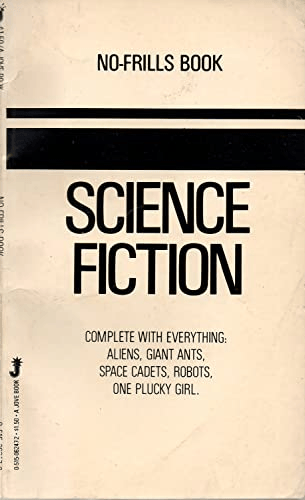
Of course, I had to look up the context. Science Fiction was apparently part of a four-book series released by Jove Books in 1981, which was intended to parody various genres. All of them were presented in the same style, and the other entries were Western, Romance, and Mystery and this particular entry was written by John Silbersack, who is not credited anywhere in the book, including in the copyright information.
The book is a strange beast, especially for the time it was released. After reading it, I can confidently say that it is a pastiche of mid-20th-Century juvenile science fiction books. In particular, I was reminded of Robert Heinlein’s Have Space Suit – Will Travel which is a genre classic and which has a very similar plot structure and details, but there were also notes of other authors from the same period. Arthur C. Clarke’s Space trilogy also felt a bit relevant, especially Islands in the Sky.
Indeed, a lot of the specific details we see in sci-fi of that era are present. Firstly, the novel predicts a base on Pluto by 2003 (!), space cadets, space drives that are pretty powerful but not astoundingly powerful, and space that is kind-of-settled but still a frontier. The first detail, in particular, leads me to believe that Silbersack was intentionally writing a throwback to 50s science fiction.
And the cover isn’t lying when it says that there are aliens, giant ants, space cadets, robots, and (exactly) one plucky girl, who happens to be the only speaking woman in the thing. In a way, that is also somewhat reminiscent of 50s science fiction, which was often not especially progressive (or cognizant) on gender equality.
For a summary of the plot, the protagonist, Alex Harrison, is a space cadet and the son of one Dr. Harrison, who was the only survivor of the disappearance of the entire Pluto colony. He is being dressed-down by an admiral on their space station, and then the whole party is sent to investigate the colony’s disappearance, which left behind an enigmatic reference to “Croatoan”—just like the mysteriously disappeared real-life Roanoke colony in Virginia. Along the way, their party is accompanied by Patrol Leader Dana Drew—the sub-titular “One Plucky Girl”.
The party travels to Pluto, and a bomb is set off in the vehicle. There’s an obligatory scene, where the clever and precocious young protagonist uses his scientific knowledge to plug the leaks—here, using a magnetic chess set. Then, they arrive at Pluto, and Dana and Alex are sent to a different location, full of robots, while the rocket explodes, leaving Dr. Harrison and the Admiral’s status unknown. The robots take them to a Dr. Carberry, which, as one Goodreads commentator pointed out, is a fictional professor at Brown University (https://en.wikipedia.org/wiki/Josiah_S._Carberry). With the professor’s help, they meet the leader of the robots, a telepathic machine named Poppy, which sends the whole party to a library planet, to look for information that might help them find the missing colony.
From there, they encounter the giant ants mentioned and have to flee the library planet in a spacecraft, and find out that the ship’s navigation system conveniently has an entry for Croatoan, and they fly there. There, they discover that humanity is on trial, from a council of animalistic aliens, who condemn Earth to destruction. Our intrepid protagonists break out, save the Earth, and fly home.
Now, as I said, the similarities to Have Space Suit – Will Travel are the most obvious. There, a young, precocious protagonist is sent on an unexpected space mission, meets a plucky girl, uses his wits to save her life, and then meets aliens, who judge Earth and decide to destroy it, before preventing this, although I think that Have Space Suit executes on the formula much more competently. There, the protagonist has a lot more directly-applicable space knowledge, from building his spacesuit, and the final scene is solved by convincing the aliens to spare humanity, instead of breaking out and blowing up a lot of their home planet.
The protagonist’s starting situation, however, feels a lot like a typical “Space Cadet” story, a la Islands in the Sky by Arthur C. Clarke, where the protagonist is a teenager transported into space, although I believe that this was a classic trope of the era. “The era” being the 50s.
And that’s what’s so strange about No-Frills Science Fiction. It’s parodying an era that had already passed. By that time, SF as a genre wasn’t just space cadets and gyrojets, it had had major successes in cinema with Star Wars, Alien, and A Clockwork Orange—or at least Silent Running, Soylent Green, and 2001: A Space Odyssey. In literature, at that time, social science fiction was really in its stride, and authors like LeGuin were doing their thing and really redefining what science fiction was. Even looking at sci fi parodies of that approximate era, we see things like Airplane II (1982) and Spaceballs (1987), which are clearly from a different era.
Reading through it, there are also a fair number of touches that feel really pointed. At one point, Dr. Carberry says that “we’re powered by the Groban-Fischer effect… it hasn’t quite been worked out yet on Earth, but the theory is sound and it would account for our odd doppler shift,” and to me, that is mocking the tendency of old science fiction novels to latch onto specific scientific theories—something which hasn’t exactly changed today.
The author, John Silbersack, is a quite prominent science fiction editor and agent today (https://sf-encyclopedia.com/entry/silbersack_john) and currently is one of the adminstrators for the Philip K. Dick award (https://en.wikipedia.org/wiki/Philip_K._Dick_Award/), and as far as I can tell No-Frills Science Fiction was his first published work of fiction (https://www.isfdb.org/cgi-bin/ea.cgi?2752). According to these websites, he was born in 1954, and I suspect that he wrote this story as a homage to the science fiction that he grew up with. In that way, it’s sort of a distillation of a lot of the works of that time, which, I think, it does a good job of. I’m not sure what else I expected from No-Frills Book: Science Fiction (etc.).
In any case, I wouldn’t strictly recommend reading it. I think it’s somewhat instructive in that a lot of things are done very efficiently, but I think that it also loses a bit in terms of clarity and quality for it. If you’re looking for a parody of ‘50s science fiction, this is bang on the money.
 J. E. Landau
Leave a comment