One problem I’ve been thinking about recently is how to handle the art of the future. I don’t think it’s done well. How can it be done better?
Imagine that you’re an art historian in the year 1900. Can you predict the art of today? Certainly, if you were to take such a person, and drag them into the future, they’d be able to understand today’s art. After all, the early 20th century was a time of abstract art and significant experimentation. Mondrian and Picasso were active in art at the opening of the 20th century and pursuing avant-garde projects, although Picasso’s cubist period would only come a few years later. Despite this, we have seen very few accurate predictions of what the art of the future would look like, even if the people of the past would understand that art.
I think that part of the problem is that it’s really difficult to predict the future, and science fiction writers who are smart will usually avoid trying more than they have to. Another factor is that knowing about other kinds of art is a skill that has to be cultivated and worked with, and most writers are focused on literature more than anything else as an inherent property of the trade.
Still, there is some value in depicting the future of aesthetics. Firstly, it can serve the role of creating a setting. In one of my favorite novels, Fitzpatrick’s War by Theodore Judson, there is a passage near the beginning of the book that describes the art that was popular in America before the apocalypse:
“What the Americans thought was music was all yah-yah and buzz-buzz made when the Yellowjackets were in power; the recordings sounded as melodious as an artillery barrage wedded to the screech of a train careening from its tracks. I expected—and my expectations proved to be correct—that any visual images from that time would reflect the same mental chaos.”
The same characters are shown to enjoy very sedate music and things like dancing are right out, and this passage helps to build a disconnect between the protagonist’s world and the world that the audience lives in, to illustrate the differences between them. Similar passages can be seen in We by Evgeniy Zamyatin:
“What difficulties our predecessors had in making music! They were able to compose only by bringing themselves to strokes of inspiration,—an extinct form of epilepsy. Here you have an amusing illustration of their achievements: the music of Scriabin, twentieth century. This black box… this box they called the ‘Royal Grand.’ They attached to this the idea of regality, which also goes to prove how their music.…”
But Zamyatin goes even further, going on to describe the music of his fictional society:
“With what a joy I listened afterward to our contemporary music. It was demonstrated to us at the end of the lecture for the sake of contrast. Crystalline, chromatic scales converging and diverging into endless series; and synthetic harmony of the formulae of Taylor and McLauren, wholesome, square and massive like the ‘trousers of Pythagoras.’ Sad melodies dying away in waving movements. The beautiful texture of the spectrum of planets, dissected by Frauenhofer lines … what magnificent, what perfect regularity! How pitiful the wilful music of the ancients, not limited except by the scope of their wild imaginations!”
Still, the music is mostly described by contrast, and then only vaguely. I am not intimately familiar with music, but I believe that this is a somewhat bizarre description that would be alien to a modern person, and I think that might actually be good, in that it is illegible (see my post, The Value of Illegibility) which makes it feel novel and strange.
In visual media, future art is even harder to avoid. Blade Runner uses it to great effect, by depicting a future where all seen art is corporate in nature, helping to build up the corporate dystopian future that the world takes place in. Even performance art, such as the dancer that Deckard talks to in the middle of the film, has been corporatized, with the act incorporating a snake that has been created as a megacorporate product.
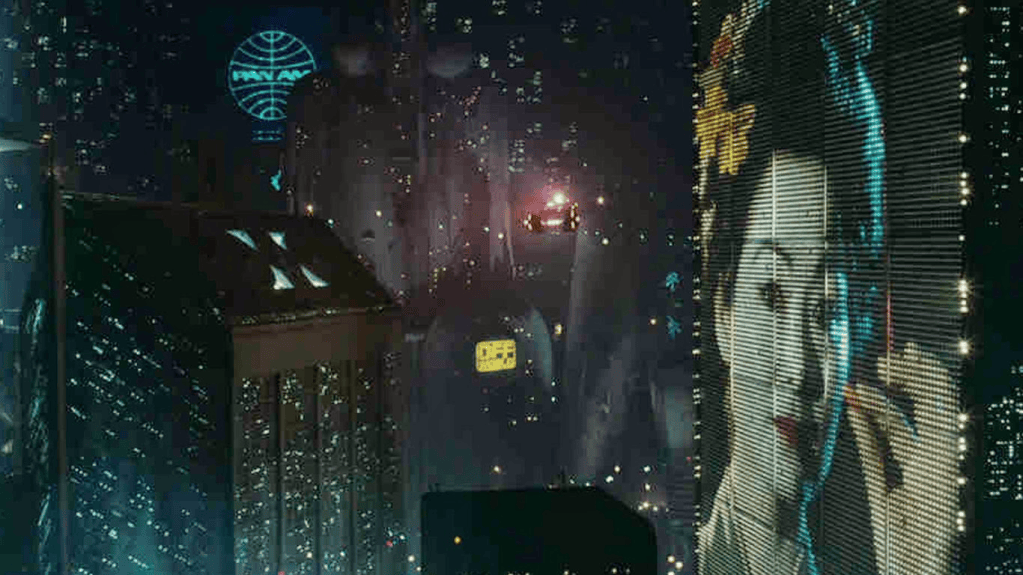
On the other hand, cyberpunk media that focus m ore on the “punk” side of things have often placed an emphasis on the relationship between official media and counterculture, such as in Cyberpunk 2077, where there is an aesthetic clash between SAMURAI, a band/militant organization and the sorts of aesthetics espoused by their major enemy Arasaka, or the various pieces of art put up by the game’s transhuman gangs. Some of the most interesting pieces of art in that universe, however, are those owned by wealthy and powerful people.
There, we see a variety of styles. Traditional art can be found, particularly in the Japanese Arasaka corporation (something that is a staple of the cyberpunk genre more broadly, which has often been interested in Asian aesthetics due to the rising economic of influence of first Japan, and then China at the times where it was developed). Then another apartment, owned by a wealthy family in the city, has a combination of more conventional abstract art and more digital techniques.
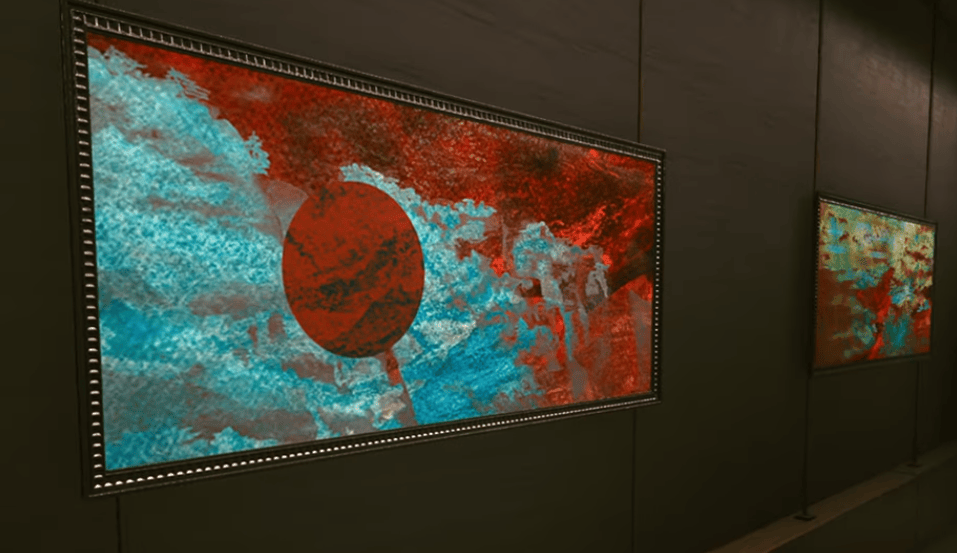
In a lot of ways, they remind me of the real-life art of Petronio Bendito, an arts professor who focuses on using computerized techniques to create art that blends the blatantly technological with more traditional artistic styles. Another strong example of this could be pieces from Faig Ahmed, who uses software to create surreal and impossible rugs, often with significant technological aesthetics.

And in both of these cases, those precise technological aesthetics are inspired by the technologies available today. For example, several of the pieces play with CRT deconvergence, where colors become misaligned and separate on a TV screen, and I think that’s a very interesting direction to explore in science fiction. For example, a society with very advanced biotechnology might be interested in creating art based on the malfunctions of that technology—mis-born creatures, alien proteins, bizarre surface textures.
Technology also influences what is possible for artists to do. For example, before the invention of acrylic paints, it was impossible to do thick, three-dimensional smears of paint with preexisting oil paint, because it simply wouldn’t form those shapes. You’re unlikely to see artists who work like Jackson Pollock without industrial manufacturing of paint and you could hardly have computer-designed rugs like Faig Ahmed creates without the computers that allow you to design them.
So, in the future we could have new materials, new techniques, new skills, new tools, and new ways of planning. We could also have vastly more of them.
Science fiction has often made much of post-scarcity civilizations, and I think that one place where such a civilization most from our own would be in an attitude towards art. If you are living in, for example, Star Trek, it is much easier to live your entire life as an artist, since you would not have to worry about money or survival. In settings where post-scarcity technologies are much more widely proliferated, like Eclipse Phase, artists can also do large-scale radical projects, like turning whole planets into art pieces with nanotech.
With extreme technological sophistication, you might see art that becomes increasingly cosmic and destructive, such as in Liu Cixin’s Sea of Dreams (also known as The Low-Temperature Artist. There, a powerful alien comes to Earth, freezes the oceans, and lifts them into the sky in large chunks as an art piece, causing massive destruction on the planet. This alien doesn’t think of itself as malicious, and merely selected the Earth because it has an audience and liquid water to work with, and then it leaves, indifferent to the fate of humanity. I imagine that with such universal powers, you might see people arranging whole solar systems as art, creating clear meaning in the orbits, and maybe even wiping out whole civilizations.
Another thing to consider is that art tends to reflect the values of the society that it is made in. This doesn’t mean that these artworks necessarily embrace the values of their society, as seen in the earlier examples of We and Blade Runner, but that they interact with and were created in conversation with them. After all, in real life we have rebellious artists, who sometimes accept great personal risk in service of their artistic ends, and so art shown in a society might be pointing out that culture’s problems and the artist’s frustrations. Art is, therefore, a potentially very powerful tool for creating a setting in the audience’s mind.
In Nazi Germany, art that the regime proscribed also had a place in its propaganda machine, calling it “Degenerate Art” and putting it on display. By doing this, the regime described what it was not and mocked its enemies, while tying arts into its racial and cultural beliefs, helping to further its propaganda campaigns. This is what was discussed earlier, in Fitzpatrick’s War and We, but I think that too often science fiction authors take the shortcut of describing what the art of the future is not, instead of describing what it is.
The real obstacle, I think, is that art is reactive to itself. Art movements are often built on their opposition to the movements of the generation before, which is why you see swings between impressionism and realism, abstract and representative, joyful and dark. Far in the future, it’s less of an issue, because you can imagine things colliding and changing from interaction with one another for a long time, and the end result not being visibly linked to anything we have today (see how different art from a thousand years ago is!) but for near-future science fiction, this is a major obstacle, because the reaction you have to predict is to the art that we have right now. And if you already knew what that reaction was going to be, you could be a very successful artist.
But I don’t think that’s any reason not to try. As science fiction authors, we are trying to create whole worlds and societies, and those societies don’t have to become real. They only have to feel real, which is why I think it can be a mistake to focus too much on worldbuilding. Art is extremely efficient, because it combines feelings and ideas and culture together, so I think it’s a great part of settings, and catching the wrong future trends is alright. The important thing is that the fictional art needs to say something and allow the characters to say something. It needs to serve the story, and not the other way around.
In Fitzpatrick’s War and We the art establishes the values of the culture, tells us quickly how they differ from ours, and creates the protagonists as people who largely conform to their societies, allowing for them to change later on. In Blade Runner, Deckard is surprised that even exotic dancing has become artificial, reflecting his role as someone who hunts for artificial people hiding among the public. In Cyberpunk, it’s a show of conspicuous consumption in a world with extreme class divides, that the protagonist can react to for characterization, either with envy or distaste.
The main exception is something like The Low Temperature Artist, where art drives the plot as an external motivator, but even there, it provides ground for characterization of the setting & the people living it. The protagonist spends the story reacting to the disaster and trying to survive and help the world recover, instead of thinking about the meaning of the art, although that is discussed briefly. The meaning of the art to the artist in the story is important only insofar as it supports the rest of the story.
More and more lately, I have been coming to the belief that a story is something like a machine or engineered system. It has parts that come together to do something, and those parts can be understood separately before assembly. They contribute to the overall functioning of the work, and everything in a story is part of creating the final effect that the artist desires: communicating something.
Art in science fiction is an incredibly powerful tool for communication. Don’t avoid writing about it because you’re worried it won’t seem realistic. Make sure it serves the story.
 J. E. Landau
Leave a comment