Recently, I have become interested in the philosophy of identity. This is probably not especially surprising to long-term readers given that transhumanism is a recurring topic on this blog and in my writing more generally.
Now, when I talk about “identity”, you may already be uncertain of what I mean. After all, the term “identity” can be used to refer to the identities that people have, like gender, national, sexual, or religious identity, but it can also mean “identification” or “knowing that a thing is the same as itself or different from a different thing”. If you look, for example, in the Stanford Encyclopedia of Philosophy, there are several entries on different kinds of identity, but I don’t think that these philosophical investigations have gone far enough, because they have been limited by what exists and is considered likely to exist. They do not consider transhuman issues.
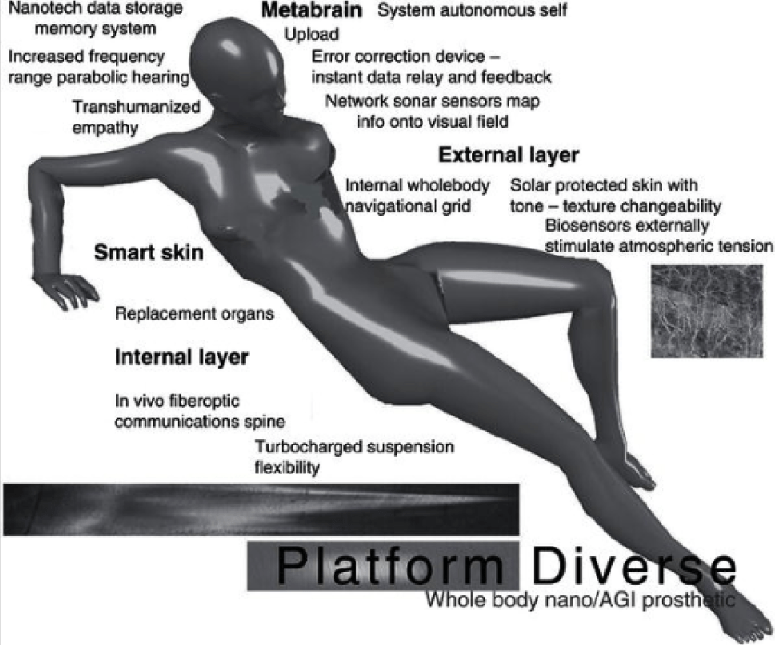
After all, we can generally expect that one identity will run in a substrate of one brain which is associated with one body, and that for each body there will be, at most, one brain operating one identity. Now, of course, we can already come up with a few counterexamples. For example, some people suffer from a mental health condition called Dissociative Identity Disorder which is somewhat controversial from a scientific and medical perspective, but which involves a single body supporting multiple “personality-states” that may believe themselves to be distinct people and which generally have disjunctions in memory. Alternatively, people can change pretty dramatically as a result of their life experiences. While most of us would say that we have elements of the people we were as children, I think that most adults can say that they have matured and grown significantly as they have aged. In a more extreme and discontinuous case, people who suffer from traumatic brain injuries can experience significant shifts in personality and can also suffer from memory problems. I, personally, believe that I have suffered from mild brain damage due to a serious childhood illness, and I can say that I have experienced some (fortunately relatively mild) shifts in personality.
Now, because in these real-world situations, people do not change their body, the question of identity can be resolved rather simply: if you have the same body, you are the same person. Now, of course, there have been lots of stories that cover the ethics of amnesia, which can start to interact with these topics. If a person commits a crime, and then suffers from amnesia, and cannot remember it, does this influence their guilt or innocence? In the US, at least, courts have historically not recognized amnesia as a reasonable defense, and it is easy for people to assume continuity.
But if transhuman capabilities are available, these questions become much more complex and difficult to grapple with.
First of all, it is possible that a person, without modification, will be moved between bodies. Are you the same person after changing bodies?
I, personally, believe that the answer can be “yes”. Now, there are lots of criteria that people like to put on this. For example, a common condition I have heard from many friends is that you can only be sure that you’re the same person before and after if the process is continuous, as in a Moravec bridge where the brain is gradually destroyed while each part of its structure is simultaneously replaced with a computerized equivalent, so the patient is awake the entire time and doesn’t notice any change in their mind at all. Now, if you believe in the soul, then this is unlikely to satisfy you, and that’s understandable, but the case of the soul is actually quite important to arguments that will be made later, so you may want to stick around for that.
Now, with the Moravec bridge, a (materialist) patient can feel confident that they are the same person, because they remember the entire process of becoming what they are now, sort of like growing up from childhood to adulthood. Now, you have a computerized person with all the benefits of that.
And now, if we copy this computerized person to a new computer, this person might feel uneasy again. How can they be sure they’re the same person? They could use a Moravec bridge again, where they transfer their brain part-by-part onto another computer. And instead of the patient sitting around for an hour or two while their brain is gradually replaced, what if it took place in a minute? Everything still happens the same way, with the brain being replaced, bit by bit, with functional equivalents, but it happens much faster. And, from there, what if it happens in just a second? Or less than a second?
What if it happens faster than you can notice? Faster than an electrical impulse can travel from one part of the brain to another? Or faster than one step in the brain-simulation of the computerized person? There is no real qualitative distinction between a theoretical gradual brain upload and one that takes place in a perceptual instant. And, of course, the patient might never be aware when their brain is started and stopped. After all, if the simulation isn’t running, they don’t exist to notice, so the only way this will affect them is in how they interact with the outside world.
Now, you may not be willing to accept that this person is the same as the person they were before, and if that is the case, then you run into a new problem: your own body changes its hardware. The cells in your body are not immortal, and they die and are replaced regularly although the speed of this varies considerably and even the often-thought-permanent nerve cells do die and regenerate over time. When you are born, your brain multiplies in size by several times over and then shrinks gradually, indicating the formation and death of brain tissues. Of course, there are plausibly parts of the personality and experience of being “you” that are driven by things other than neurons. It is believed that gut microbiota play a significant role in how people think and feel but this doesn’t mean that those things can’t be simulated and digitized, only that they add to the complexity of simulating a person. So I believe that we cannot associate the “are you the same person” function of “identity” with the physical body alone. This is a classic philosophical problem, in the “Ship of Theseus”.

And, beyond this, the brain uploading introduces new potential complexities. For example, if you can put a person in a computer, you can copy that person across computers. This means that you could have the same person simultaneously running on three machines.
Now, if a person is who they are because of they are a piece of information that can be transformed and represented in different ways (as has already been brought up), then these people must be the same if they are the same piece of data.
Of course, that does not mean that they will have their minds magically melded together, and once they start experiencing diverging events in their respective simulations, they are certain to start experiencing different things. This is the first element of identity that I want to separate from the others—the phenomenon of experiencing being you. I, personally, would say that the question of “why are you you instead of anyone else” is incoherent, because the experience of being you is a result of processes that occur in your brain. For this blog post, I would like to call this “the phenomenon of experience”. So when we say, “well, the copy of me isn’t experiencing the same thing as me, it isn’t me,” we can now more precisely say “the copy of me enjoys a different phenomenon of experience,” without getting caught up in whether or not that copy of you shares your identity.
Now, another component of personhood I like to draw out can be illustrated by a rather mundane thought experiment. If I’m drunk or high, am I the same person I was before? Well, I probably don’t act like the same person. Some people are much meaner when they are drunk or high, or much friendlier, and memory can be lost in the equation too.
Whether or not you think that you are the same person when drunk or high, it is a distinct component of identity from the phenomenon of experience, and it is not the only component of identity. And most people accept that they are the same person today that they were yesterday, and that they are likely to be the same person tomorrow, even though they will, in practice be slightly different due to the experiences that they have had in the intervening period. I believe that memories and personality traits both fall into this same part of identity, and they also come up in the cases of DID or brain injury, where personality traits can be altered significantly or memories can be lost.
But I don’t think that this is the final component of identity. Instead, I think that honor goes to the “self-narrative”, which is the story that holds together the many states of being. This is where, I think, the idea of the soul goes. And the soul is actually a great example of a self-narrative that holds when other parts of a person’s personal history are lost.
(Some) Christians believe that certain people, after death, will be resurrected into perfected bodies and with a new, sinless mind. Because Christians view sin as an essential part of every living person’s life, and something that is felt in everyone’s mind, logically, the resurrected faithful will experience major changes in their personalities. Still, Christians would say they are the same person after the resurrection, just in a purified form, because they have the same soul.

For a more secular person, the self-narrative could have a different form. It is easy to say, “well, I remember being me yesterday, and I feel like I’m me now, so that’s one person”, because this is generally true in most cases.
But this becomes much more complicated in the case of brain uploading and duplication. If you have an uploaded person, and you run multiple copies of them on different computers, these copies will remember the same, shared past, even as their present selves diverge. And this could be very disconcerting, if they are aware of each other. But this doesn’t have to be the case. Coming back to the example of religion, if you believe that you have a soul, and this soul is what makes you yourself, as self-narrative, then brain uploading becomes very simple. You copy yourself onto the computer, and if that process isn’t sufficient to extract the soul from your body, then you can easily say that your copy isn’t you. And that copy will likely be quite upset, since their self-narrative has been destroyed, provoking an existential crisis, and they may believe that they are not, in fact, a person at all.
Similarly, real life people often suffer from serious stress after having to adjust their self-narrative whether due to brain injury or other factors.
In my own life, I have been thinking about these ideas for some time, and one of my goals has been to construct a robust self-narrative that can handle unexpected changes in other aspects of the self. Currently, I operate on the basis of a self-narrative that my past is defined by a key agreement that I made, to avoid making life harder for the people I will someday be, and to respect the decisions made by past versions of me, and in that I have been able to weather major changes, including the illness I experienced. I’m not sure if this is the best long-term strategy, but so far it has worked quite well. If I were to be forked or encounter time-traveling versions of myself, I believe that this same trust strategy would be very effective, but so far these aren’t problems I have had to encounter.
As a science fiction author, however, there is enormous potential in exploring this idea. There are lots of stories about people being duplicated, ranging from books like Greg Egan’s Diaspora (always a favorite here) to popular movies like Mickey 17. By making a conscious effort to separate the elements of what we call “identity” we can explore transhuman ideals in much more complex and deep ways.
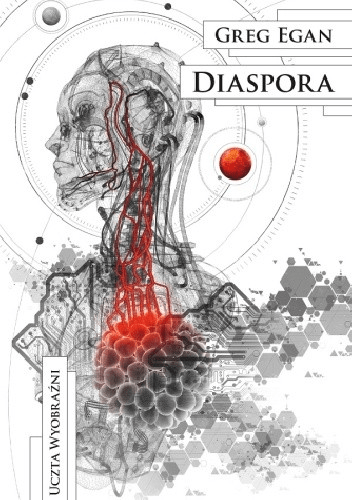
For example, Diaspora’s protagonist, Yatima, at one point ends up duplicating verself into hundreds of forks, each one slightly more modified than the last, to allow ver to establish contact with a very alien organism. There is then a discussion about how much these different forks have in common with the “original” version of Yatima, who is verself a many-times copy, sent across universes. At the same time, Yatima has a self-narrative based partly around cryptography, where residents of ver computer simulation are given unique cryptographic information that allows them to establish their identities across duplication and mutation. Even there, ve experiences a rupture in ver self-narrative, when the “bridge” of forks ends up deciding to stay with the aliens, which they consider themselves more similar to.
One concept that I am interested in is the idea of a character with a self-narrative that very freely allows for forking, modification, and other things that would normally disrupt a person’s sense of self. Such a person would be very resilient, but also liable, I think, to get distracted or all twisted up trying to fit everything together. Alternatively, it could be interesting to explore characters that are a whole roiling mess of stolen personality traits, memories, and even phenomena of experience, all messily held together by a strong-but-flexible self-narrative.
In any case, I think that separating out the components of identity makes resolving many transhuman philosophical questions much simpler, and should be helpful for any science fiction writer interested in such issues.
 J. E. Landau
Leave a comment